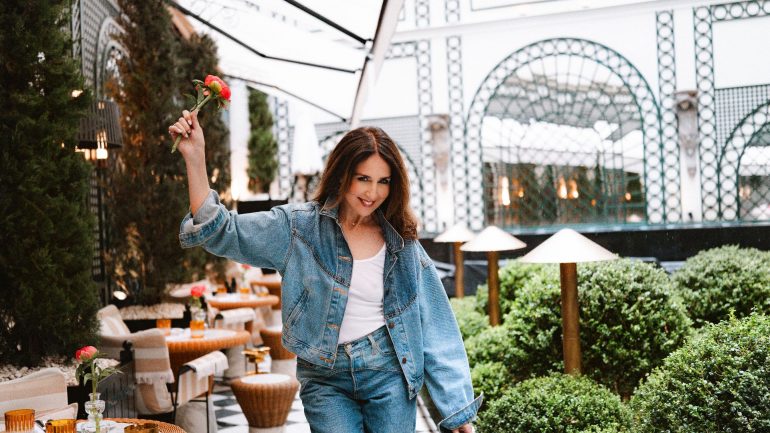
After such a rich and demanding career, what still drives you today when choosing your roles?
The encounter with a character, the encounter with a director. Entering a world I haven’t explored yet. Moving towards roles that give me vertigo, where I know I will be able to open intimate doors within myself that I haven’t opened before. Pushing myself further, frightening myself a little, never sparing myself. Embracing risk…
Do you still seek to surprise yourself through your roles?
Every single day, all the time. In every scene, I look for the miracle and for absolute truth in every second. That is the only thing that truly interests me… finding the truth of a character.
You recently spoke about artificial intelligence in cinema. Is it something that worries you or stimulates you today?
No, it doesn’t worry me. Actors are unique. Nothing will ever replace a close-up of Anna Magnani, Gena Rowlands or Meryl Streep. As Baudelaire once said, “The most beautiful emotions are those we cannot explain.” What moves me in an actor is precisely that mystery we never quite know how they do it. It can come from an undefined, almost blurred place, something impossible to qualify. What is beautiful is when an actor takes us into a mysterious territory, and that can never truly be replaced. AI should be considered as a tool, something additional for the future.
You have just finished shooting “Malika” under the direction of Mounia Meddour, where you play a singing teacher. What drew you to this role?
I had wanted to work with Mounia for a long time. We first met while serving on the Un Certain Regard Jury in Cannes. I was struck by her vitality and her energy. I was very eager to explore this character with her a singing teacher who wants to pass on her knowledge to a young opera singer with such a unique journey. The relationship between these two women fascinated me.
Looking back, how do you view your journey within French cinema?
I feel that there is still so much for me to do, so many people I haven’t worked with yet. I’ve already experienced wonderful encounters, but I still long for others vertiginous and unexpected ones. At the same time, I already feel incredibly fortunate to have travelled through such different artistic worlds.
After “C’était mieux demain”, released in 2025, what did working with Didier Bourdon bring you?
A demanding and beautifully written screenplay. At the same time, it was also a first feature film, and that made the experience even more exciting. Working with Didier was an absolute joy. I was truly seduced by the originality of the film this woman from the 1950s suddenly transported into 2025. It is a feminist film that explores the place of women in society. And since the film became such a great success, it made me very happy.
You are also preparing a film that you co-wrote with Michael Pierrard, inspired by “Mytho”, in which you will play the leading role. What can you tell us about it?
It was inspired by the character of Mytho and by the short videos I created during lockdown. Then, of course, we had to build an entirely new screenplay and a story that has nothing to do with the pandemic itself. I will also be co-directing my very first feature film. It excites me tremendously!
Are you a woman driven more by passion or by reason?
Without hesitation, passion!
What would you like to wish the readers of LiFE Magazine?
I would wish them audacity, faith, the power of dreams, and the ability to believe in their own star. And as Nietzsche once said, “One must still have chaos within oneself to give birth to a dancing star.”